
Innovation model
How we thought about designing technology for all – inclusive, sustainable innovation practices and processes.
Overview
The inaglobe innovation model was the starting point behind the platform approach that inaglobe launched in 2017. Even though we wanted to introduce social innovation into the academic space, we also wanted to make that involvement as productive as possible, not only because of the fulfilment this would give students, but also because of the incentives this built for the humanitarian partners on the ground, and eventually for potential investors and corporate sponsors.
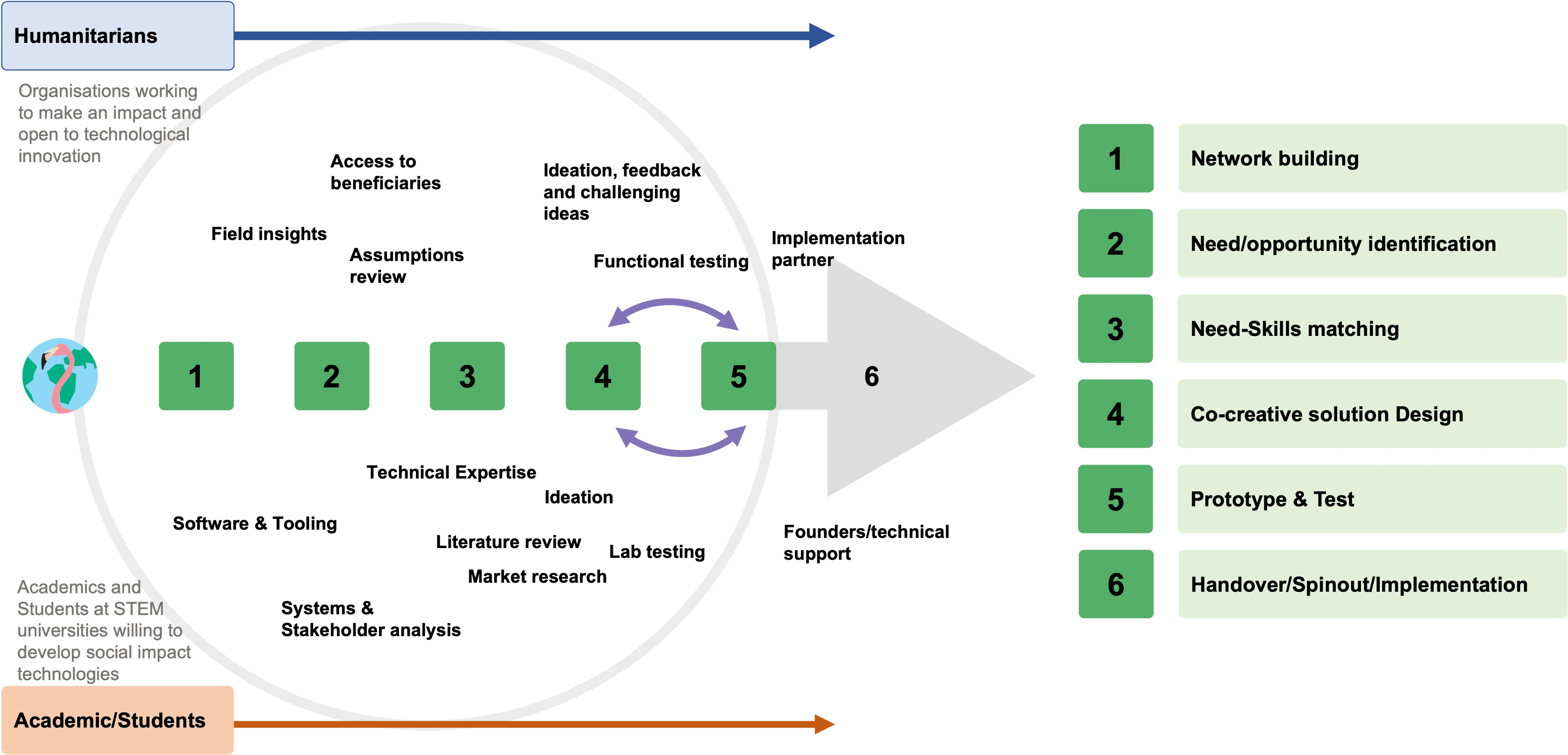
The academic space presented itself as a fertile ground for social impact innovation, as it is an environment that despite being risk averse and change averse is very inviting of high-risk innovation. It is less important at a university that a technology has ~1 in 20 chances of success, than at a corporate innovation lab or a start-up studio/incubator. The appetite for high risk projects made the academic space an unbeatable environment for frugal innovation and for redesigning systems, products and disruptive ubiquitous technologies. In addition to this, students are hungry to contribute to society, they are committed agents of change and of impact, and their time and energy could be funnelled towards a method of building technology that still is at its inception.
Furthermore, we wanted to intervene at the interface between two highly skilled systems, that of STEM education and that of Development. By combining the understanding of needs on the ground with the technical expertise to develop technology we were certain that we could have a great impact. If these two separate environments could learn to work together, we would have enabled a high-potential synergy.
Aligning the pedagogical and innovation models (the inaglobe 2017 concept)
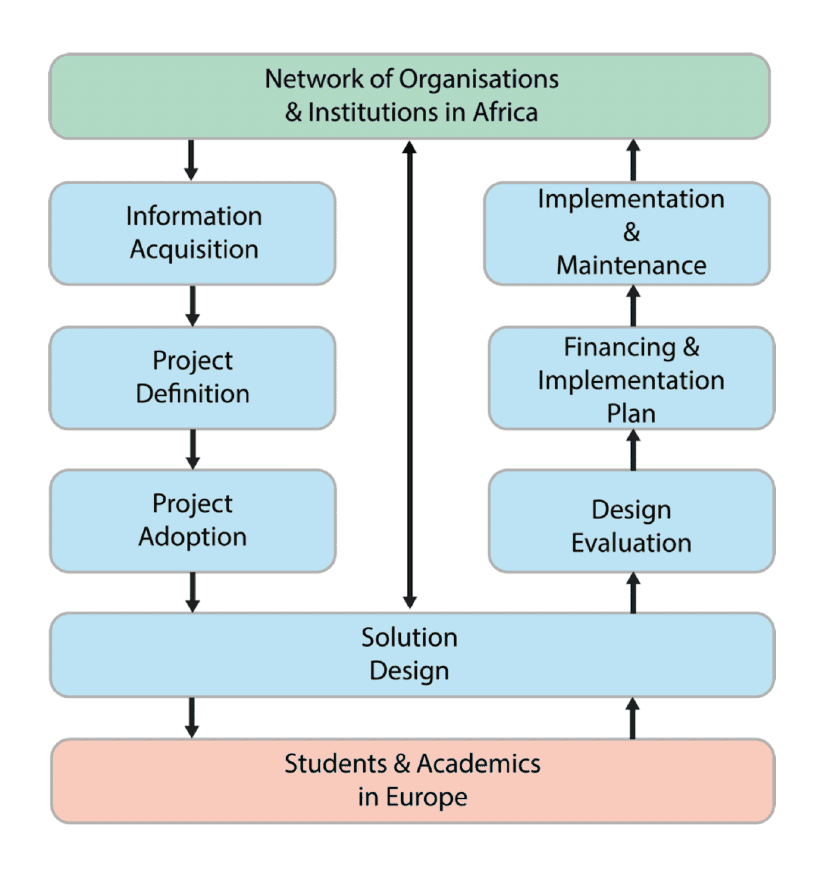
The original process conceptualised for the inaglobe model was a mix of both the pedagogical and the innovation model – we were trying to align incentives. In the following diagrams you can see how we did this. Over the years we dove deeper into the process such that it would be more adapted to the specific needs that our partners were having.
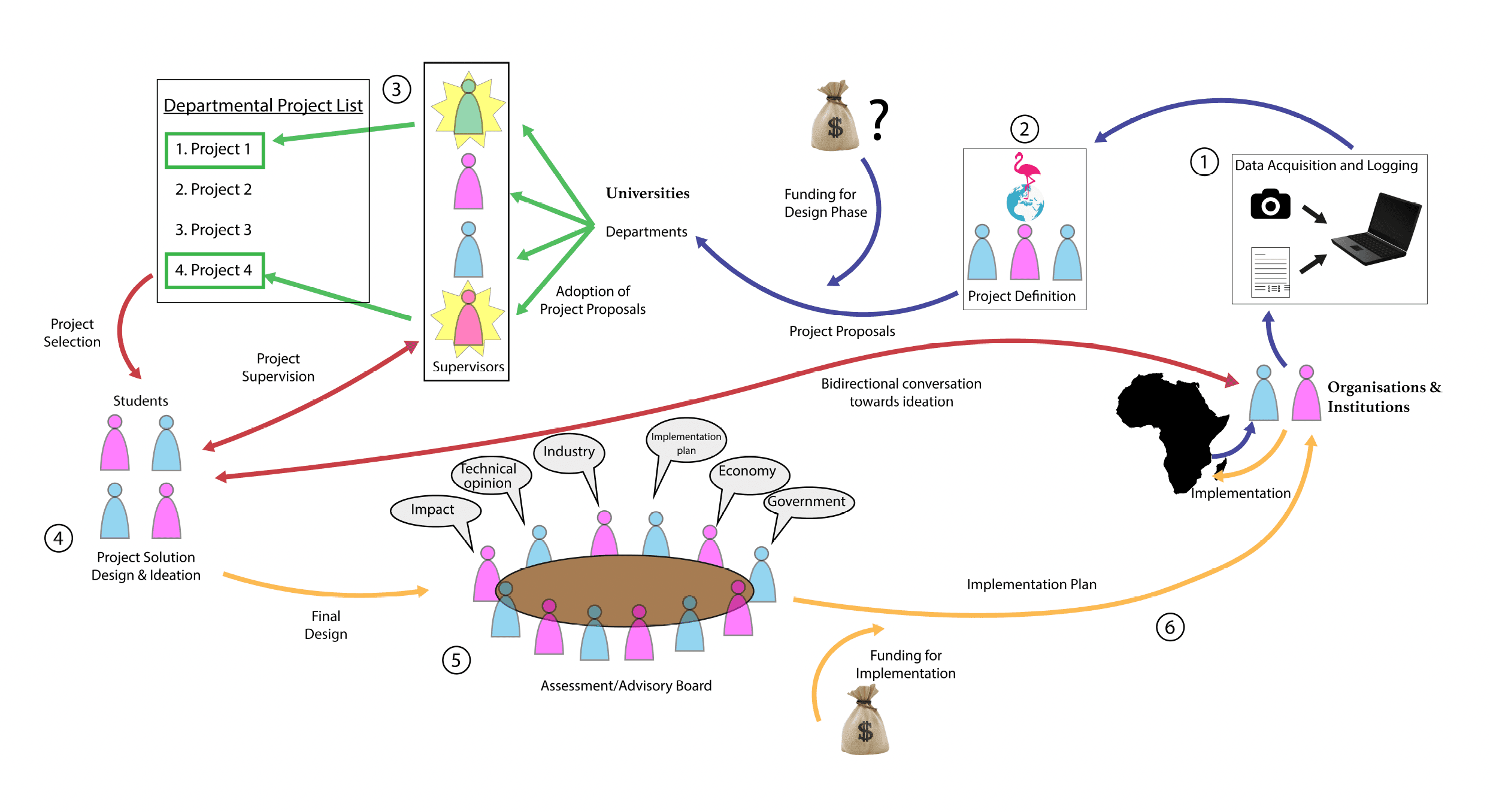
The original view was a much more linear approach to innovation, where the design process is more simple than it actually really is. The truth is that information and insight generation and thus the analytical and creative process continues deep into the testing and even roll-out phases.
Sourcing Projects
The projects we sourced have a grassroots character, representing the needs of those in low resource settings with accounts given directly by beneficiaries or by stakeholders close to the beneficiaries. This took place in different ways.
As a volunteer-based organisation, one of the ways that we gave ownership to our volunteers was to reach out to organisations that they found were doing interesting work in the field of development, and that might be open to supporting in social innovation projects. This meant that volunteers would reach out coldly to project or country managers of these organisations, and once a relationship was established together we would discuss the major problems they were experiencing and witnessing, and we deconstructed these needs into where technology may be able to support them in having an impact. We used different design and systems thinking methodologies (eg. lateral thinking or design futures) to explore the problems and needs that were being discussed. Once we agreed on what the problem statement on the ground was for them we put together a brief that would then be adapted to the project modules within the academic space.
In other occasions, projects would be submitted directly through our form by partners that wanted to work with us. Usually, these projects were a little less requiring of the design thinking process proposed but nonetheless we did filter them to make sure they were addressing a need.
Specifically, inaglobe has been reliant on Human Centred Design, Design Thinking and Systems thinking. Some of the Design thinking methodologies used for exploration of problems are outlined in GSP Impact Office: Human-centred methodologies – which was a joint training program built by the inaglobe team for the Global Shapers Hub in Paris.
Supporting Projects & Students
As part of the ethics behind the work that we do, we have not only looked for stakeholder involvement at the inception of the project, but also to have them involved throughout the creative and innovation processes, ensuring a collaborative design and co-creative approach.
As repetitive as it sounds, different projects and students require different kinds of support, and depending on the academic module one may or may not be able to provide certain support or guidance to students. What is ubiquitous is that there are certain skills that we found ourselves repeatedly infusing into our students. Namely:
- Problem framing & inquiry: We advised all students to review the problem statement, validated through triangulation, reframing or through secondary research (eg. market research or literature reviews). We encouraged students to dive deeper into the problem statement and to generalise it past the grassroots manifestation that is presented to them in the brief.
- Problem solving: We supported students in breaking down the problem into smaller parts, into mapping the system and its stakeholders and to approach the solution from different angles or points of intervention. Our problem solving approach was one of the aspects that students appreciated the most, as they saw the real world application this may have towards having an impact.
- Human centred design principles: STEM students more often than not are not taught human centred design principles (or any design thinking principles, for that matter). These methodologies enabled students to get closer to the stakeholder and to the problem. In turn this helped align the teams internally, but also with the humanitarian partners what the solution needed to be to the given problem.
- Collaborative design & co-creative processes: Working collaboratively with the stakeholders and involving them in the design process is a complex way of doing things, but it is extremely valuable for the students as it breaks them away from working in silos. Supporting students in these approaches was paramount for both their learning but also for their solutions.
- Time management: Students are given often given a very theoretical academic experience, which means that certain soft skills suffer. These students are also subject to high pressure learning environments as STEM subjects tend to be demanding. This means that often by necessity students end up being very efficient in their work. What we found is that helping students organise their time and their deadlines was extremely beneficial for the outcome of projects. The most notorious failed projects were those that couldn't package things into reasonable timeframes.
- Project Management: In the same spirit as Time Management, Project Management skillsets were often ones that helped students greatly. By breaking down the work into tasks and in turn build the necessary documentation to communicate on progress, they could more effectively justify their decisions, involve stakeholders and thus build better solutions. We often spent time helping students organise their work such that they could approach their projects in a structured manner.
- Prioritisation: Lastly, students heavily benefitted from prioritisation of both solutions, and ideas, as well as tasks. By introducing them to different prioritisation frameworks, they were able to make decisions on the basis of tradeoffs and evaluations. These often helped them make progress in a logical manner, logging assumptions and challenging their understanding of the problem as they moved ahead. Typical prioritisation frameworks/matrices we provided were:
- Time – Benefit
- Risk – Certainty
- Effort – Impact
Spinning out & Implementing Projects
Out of all the projects we ran we realised that the implementation side was often very complex and diverse, thus it was often on a case-by-case basis. Generally we can profile the different spin outs as:
- Social enterprises (for-profit) – these projects often followed a start up approach, going through start up competitions, incubation programmes, although they also opted for grants whilst they remained in the academic space in order to raise non-diluting funding (eg. Paige Braille).
- Charities & non-profit social enterprises – these projects often relied on both grant funding as well as donations from private and corporate individuals. The remit of these projects were usually focused in a specific location (eg. uDrops).
- Knowledge and Technology handovers – These implementation approaches depend on a strong third party entity (on the humanitarian side) that can take ownership of what was developed. In the case of analyses and reports, these can be immediately used by the organisations to make informed decisions (eg. ModeRe), and in the case of technology transfers it is important to have a tech or academic partner involved with the humanitarian partner which has the capacity to do the roll out (eg. Sapuraua Blow Moulder).
Having said this, many implementations didn't go as planned, implementation partners often lacked the capacity to manage some of the technologies built, and sometimes students did not have the bandwidth to support either due to skillsets or because of time/changing priorities. This is testament to why building a transdisciplinary network is important.
Part of the inaglobe vision, as stated in the section on Business Models, is that we would provide a financing platform for the work being spun out as a result of the projects. This had a great potential in ensuring the success of many of the projects that saw themselves constrained by the pro-bono nature of the engagement.